Bee Learning and Memory (What Happens When You Train a Bee Like Pavlov Did)
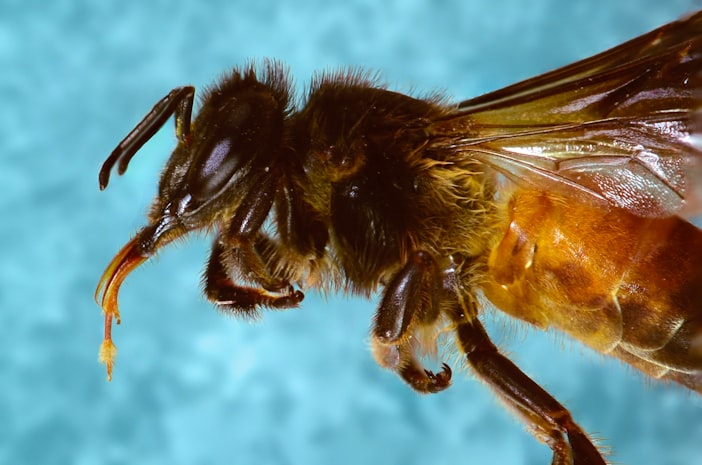
In 1993, Martin Hammer put an electrode into a bee brain and found a single neuron responsible for the entire reward signal in olfactory learning. One neuron. In mammals, the equivalent circuit - the dopaminergic projections that signal "this thing came with a reward" - involves thousands to millions of neurons spread across multiple brain regions. Hammer named his discovery VUMmx1. Ventral unpaired median neuron of the maxillary neuromere 1. A name that's simultaneously precise and completely unilluminating, but it points to exactly the right cell, so presumably that's what counts.
What VUMmx1 does: it fires when sugar touches the antenna. If it fires while the bee is smelling a flower, she learns that flower means food. From one experience. And the learning, once formed, is indistinguishable in its molecular architecture from human long-term memory - the same protein synthesis, the same synaptic strengthening, the same rules about when memories consolidate and when they fade.
The bee brain runs the same learning algorithm as the mammalian brain. It just uses a fraction of the components. The backstory begins 32 years earlier, with a restrained bee and a short Japanese paper.
The Setup
In 1961, Mamoru Takeda published a demonstration that honey bees could be classically conditioned. He restrained a bee in a small tube, touched her antenna with a sugar solution (she extended her proboscis reflexively to drink), and paired the sugar with a specific odor. After a few pairings, the bee extended her proboscis to the odor alone, before the sugar arrived.
Pavlov's dog, at insect scale. The sugar was the unconditioned stimulus - it automatically triggers the response. The odor was the conditioned stimulus - it acquires the ability to trigger the response through association. The proboscis extension was the conditioned response. Classical conditioning, the most fundamental form of associative learning, worked in an organism with a brain containing roughly 960,000 neurons.
The reflex itself is hardwired. Touch a bee's antenna with a sugar solution and the proboscis extends within 200 to 300 milliseconds. The bee doesn't decide to extend. The signal runs from the gustatory receptors through the subesophageal ganglion to the muscles of the proboscis automatically. The experiment begins when you pair the sugar with something else - an odor, a color, a vibration - and ask whether the bee can learn the association.
She can. In one trial.
A single pairing of an odor with a sugar reward is sufficient to produce a conditioned response. One experience, one memory formed. This is considerably more efficient than rats, which typically require multiple trials to form the same type of association. The bee's one-trial learning reflects the ecological pressure she evolved under: a forager has two to three weeks to make her career, and every minute spent relearning something she should already know is nectar she didn't collect.
Takeda's paper didn't immediately shake the foundations of neuroscience. But the paradigm he established - the proboscis extension reflex, or PER - became, over the following decades, one of the most productive experimental systems in the study of learning and memory. Thousands of papers, a Nobel laureate's worth of neurological insight, and policy-influencing pesticide research. All from a bee in a tube and a puff of odor.
The Apiary Project tracks honey bee health data so you don't have to.
Explore the Data Hub →What Bees Learn
The PER paradigm has been used to probe an inventory of learning abilities that would be remarkable in any vertebrate. A bee trained with odor A rewarded and odor B unrewarded learns to discriminate between chemically similar odors - different concentrations of the same compound, structural isomers that differ by a single chemical bond.
She does reversal learning: train her that A is rewarded and B isn't, then reverse the contingency, and she updates. She learns the new rule and suppresses the old association. Reversal learning is used as a test of executive function in primates. In bees it doesn't appear to require special equipment.
She does contextual learning - odor A predicts reward in the morning but not the afternoon, or in one location but not another. The association is tagged with context, not just smell. And she does negative patterning: present odor A alone and it's rewarded, odor B alone and it's rewarded, A and B together and it isn't. The mixture is a distinct entity from its components, and the bee treats it that way. That form of non-linear discrimination was long assumed to require mammalian cortex.
Her memory architecture matches the mammalian model in ways that keep surprising researchers. A conditioned response that stops being reinforced gradually extinguishes - the bee stops extending her proboscis. But hours or days later, the response spontaneously recovers. The original memory wasn't erased; it was suppressed by a competing inhibitory memory. This is exactly what Pavlov described in dogs in the 1920s, down to the spontaneous recovery timeline. A single conditioning trial produces short-term memory lasting minutes to hours. Three spaced trials produce long-term memory lasting days. The transition requires protein synthesis - treatment with protein synthesis inhibitors after training blocks long-term memory formation while leaving short-term memory intact. Same molecular gate that consolidates memories in mammals. Same switch, different brain.
VUMmx1
Which brings us back to Hammer and the single neuron.
VUMmx1 is octopaminergic - it releases octopamine, the insect equivalent of norepinephrine in mammals. The neuron has its cell body in the subesophageal ganglion and sends projections to the antennal lobe, the mushroom body, and the lateral horn, precisely the brain regions involved in olfactory processing and associative learning.
Hammer's experiment was elegant. He showed that injecting octopamine directly into the mushroom body while presenting an odor - substituting a chemical injection for the actual sugar reward - was sufficient to produce a conditioned PER. The bee learned to respond to the odor as if it had been paired with sugar, even though no sugar was ever presented. VUMmx1 was the reward signal. Activate it, and the bee learns.
The identification of a single reward neuron was a remarkable finding partly because of what it implies about efficiency. In mammals, the dopaminergic reward system requires thousands to millions of neurons to do a job that the bee's brain accomplishes with one. Not because the bee's learning is simpler - the behavioral complexity is roughly comparable - but because the bee's brain allocates its resources differently. Each neuron, apparently, does more.
This is also what makes the bee brain valuable to neuroscience. The principles are the same as in mammals. The circuit is small enough to map. You can't do single-neuron resolution studies in a human brain learning to associate a smell with a reward. You can in a bee brain.
The Mushroom Bodies
The neural architecture supporting bee learning is centered on the mushroom bodies - paired structures in the front of the brain that receive input from the olfactory system, the visual system, and other sensory modalities. They contain approximately 170,000 intrinsic neurons called Kenyon cells, roughly 18 percent of the entire brain's neuron count.
In forager bees, the mushroom bodies are physically larger than in nurse bees, and they grow during the transition from in-hive work to foraging. Not from cell division (adult insects don't add neurons) but from neuropil expansion - the elaboration of dendritic arbors and synaptic connections as the bee accumulates spatial and olfactory memories. The brain you can measure under a microscope after a forager's career is physically different from the brain she had when she started.
The mushroom body functions as an associative matrix. Olfactory input provides the "what" signal. The reward signal - VUMmx1 firing because sugar is present - arrives through a separate pathway. Their convergence in the mushroom body strengthens the synaptic connections between the Kenyon cells representing the odor and the output neurons that drive behavior. After conditioning, the odor alone activates those connections and the proboscis extends.
The same mechanism operates in the mammalian hippocampus and amygdala during associative learning. Different regions, different architecture, different neuron counts by a factor of 90,000. The computational principle - strengthen connections between neurons that fire together during a rewarding experience - is conserved across the gap between insect and mammal.
The Pesticide Assay
The PER has become a standard tool for assessing sublethal effects of pesticides on bee cognition. A pesticide that doesn't kill a bee outright may still impair her ability to form associations between floral scents and rewards, to navigate home from a food source, to remember which flowers are currently paying.
The experimental design is straightforward: condition a group of bees using the standard PER paradigm, compare learning performance between pesticide-exposed bees and controls. What percentage show a conditioned response after one trial, three trials, five trials? How long does the memory persist?
Neonicotinoid pesticides - imidacloprid, clothianidin, thiamethoxam - consistently impair PER learning at sublethal doses. Exposed bees require more trials to learn, form weaker memories, and show reduced long-term retention. The mechanism: neonicotinoids bind to nicotinic acetylcholine receptors in the mushroom bodies, disrupting the synaptic transmission that underlies associative learning. The bee doesn't die. She just can't learn as well. A forager that can't learn as well brings back less nectar, visits the wrong flowers, and contributes less to the colony - effects that cascade through the hive while being invisible to anyone watching from outside.
The PER assay has been cited in risk assessments by the European Food Safety Authority, the US EPA, and Health Canada. A humble tongue-extension test, first described in a short 1961 paper, shaping pesticide policy on three continents.
Counting, Sort Of
In recent years, PER and related choice experiments have been used to ask whether bees can represent numerosity - the number of items in a set.
Scarlett Howard and Adrian Dyer at RMIT University trained bees in Y-maze choice tasks. A bee enters a maze and sees two displays - one with three shapes, one with five shapes. She learns the display with three shapes leads to a sugar reward. She can then transfer this learning to novel shapes she's never seen, demonstrating she's responding to the number of items, not their identity.
Bees trained in these paradigms can discriminate between quantities up to about five, learn the concept of zero (choosing a blank display over one with shapes, when zero was the rewarded option), and perform something resembling addition and subtraction when trained with specific rules. These findings don't mean bees do math. They mean the bee brain can represent approximate quantities and apply rules to those representations - a capacity shared by fish, birds, and primates. The bee adds to the evidence that basic numerical representation is ancient, conserved across vastly different brain architectures and neuron counts.
The Small Brain Problem, Reversed
The usual framing asks how a 960,000-neuron brain produces learning behavior that, in mammals, requires billions of neurons. The more interesting question might be: why does the mammalian brain need so much to accomplish the same things?
Part of the answer is sensory bandwidth. A mammalian visual system processes far more information per second than a bee's compound eye. More input channels require more processing neurons. The bee's sensory world is smaller, and her brain is proportioned to it.
Part is behavioral flexibility. A rat can learn arbitrary associations between almost any two stimuli in almost any modality - the bee's learning, while impressive, is more constrained. She learns olfactory-reward associations most easily, visual-reward associations with more difficulty, and some cross-modal associations barely at all. The bee's brain is optimized for the associations she actually needs: flower scent predicting nectar, landmark patterns predicting home. The mammalian brain is a general-purpose learner. The bee's brain is a specialist.
And part is coding efficiency. The mushroom bodies use sparse representation - an odor activates a small fraction of the 170,000 Kenyon cells, rather than large fractions. With sparse coding, 170,000 neurons can represent more distinct odors than a bee will encounter in her lifetime. The mammalian brain may simply be less efficient per neuron, requiring more cells to achieve the same representational capacity.
Sugar Water and Insight
Takeda's 1961 experiment asked a simple question: can a bee learn an association? The answer - yes, in one trial - opened a window into a brain that operates on the same principles as every other brain studied, but does so with fewer neurons than some earthworms have.
Sixty-five years of PER research revealed a reward neuron that operates identically in bees and mammals. Mushroom bodies that function like a simplified hippocampus. Memory consolidation that requires protein synthesis in both bees and humans. Extinction that suppresses but doesn't erase, in both bees and rats. Learning rules conserved from insect to primate.
The bee is not a simple organism running on instinct. She's a learning organism running on a brain staggeringly efficient - solving with 960,000 neurons what mammals solve with 86 billion, using the same computational principles, the same molecular mechanisms, the same behavioral rules.
All of it visible through a proboscis that extends when a bee smells something that once came with sugar. Touch the antenna. Present the odor. Watch the tongue. The simplest experiment in neuroscience, running on the most efficient brain in the laboratory, revealing the same truths about memory that Pavlov found in dogs and Kandel found in sea slugs.
The bee extends her tongue. She remembers.